
This is the single biggest reason Vite feels fast.
Webpack bundles first.
Vite doesn’t.
Instead, Vite leverages:
Native ES Modules (ESM)
Modern browsers already understand JavaScript modules.
Example:
import { useState } from "react";Browsers can load modules individually without needing one giant bundle.
So Vite asks:
“Why bundle the entire app during development if the browser can already handle modules?”
That question changed everything.
How Vite Works Internally
When you start a Vite dev server:
npm create vite@latest
npm run dev
Vite does almost no upfront bundling.
Instead:
Source files are served on demand
The browser requests only the modules it needs
Modules are transformed dynamically
Updates are handled at the module level
This massively reduces startup cost.
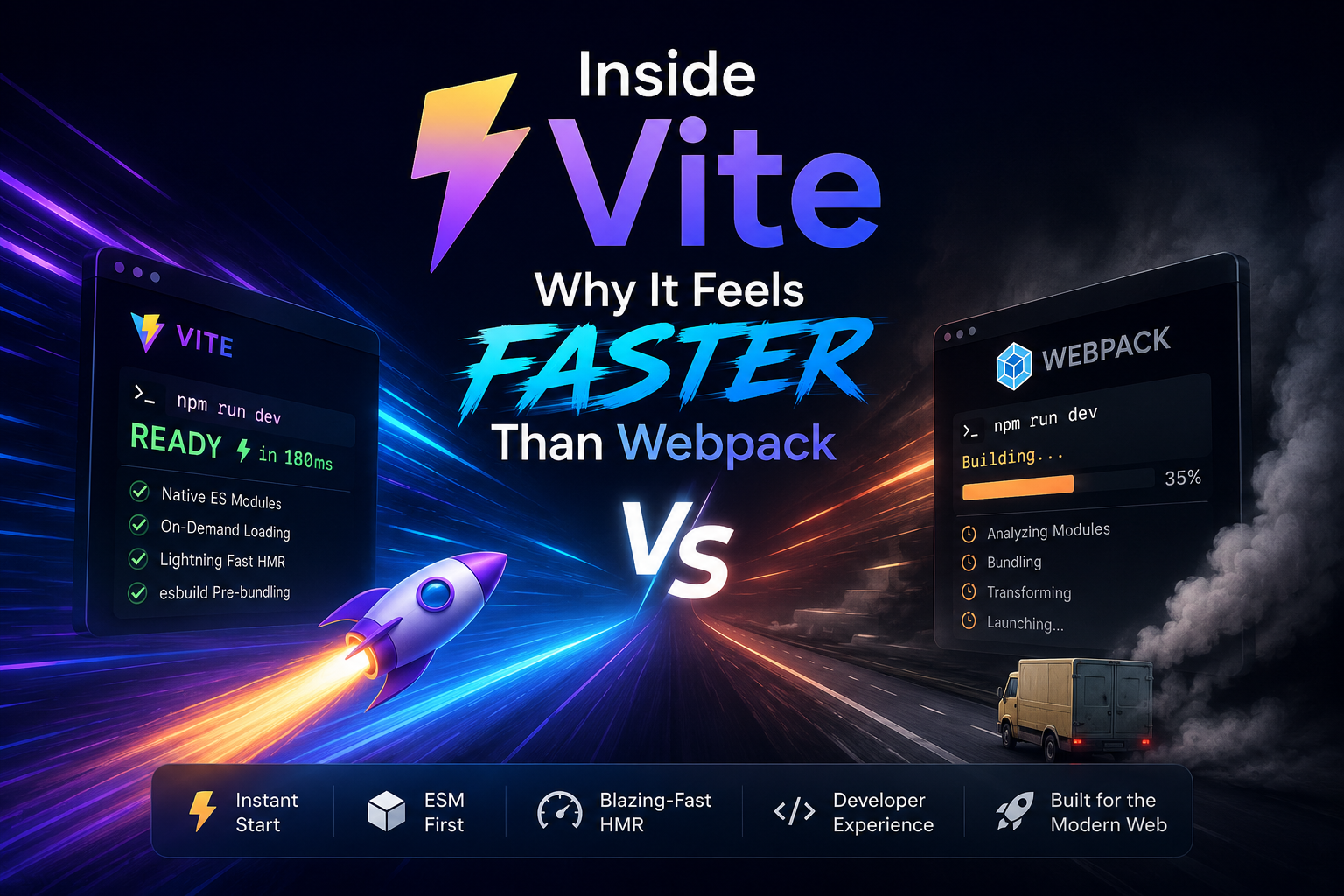
Webpack vs Vite Startup Flow
Webpack Development Flow
Start Dev Server
      ↓
Analyze Entire Dependency Graph
      ↓
Bundle Everything
      ↓
Transform Files
      ↓
Launch Application
Vite Development Flow
Start Dev Server
      ↓
Serve Files On Demand
      ↓
Browser Loads Only Needed Modules
Much less work happens upfront.
That’s why Vite startup feels nearly instant.
The Secret Weapon: esbuild
Another huge reason Vite feels fast is its use of:
esbuild
Webpack’s ecosystem historically relied heavily on JavaScript-based tooling like Babel.
Vite uses esbuild for dependency pre-bundling and transformations.
And esbuild is insanely fast because it’s written in:
Go
compiled natively
highly parallelized
This makes operations like:
TypeScript transpilation,
JSX transformation,
dependency optimization,
dramatically faster.
Dependency Pre-Bundling Explained
At this point you might ask:
“If Vite doesn’t bundle during development, why does it still use esbuild?”
Because dependencies from node_modules can still be expensive.
For example:
import React from "react";
import lodash from "lodash";
Some packages ship:
CommonJS modules,
many internal files,
inefficient dependency structures.
Vite solves this with:
Dependency Pre-Bundling
Using esbuild, Vite:
converts dependencies to ESM,
optimizes them once,
caches the result.
This makes subsequent server starts extremely fast.
Why Hot Module Replacement Feels So Fast
Hot Module Replacement (HMR) is where Vite truly shines.
Webpack often rebuilds significant portions of the dependency graph after changes.
Vite updates only the affected module.
Example:
export default function Button() {
  return <button>Click Me</button>;
}
If this component changes:
Vite invalidates only this module
pushes the update instantly
avoids rebuilding unrelated parts of the app
Result?
Near-instant updates.
Webpack’s Architecture Was Built for a Different Era
This doesn’t mean Webpack is “bad.”
Webpack solved incredibly difficult problems for years.
In fact, many enterprise systems still depend heavily on it.
But its architecture originated before:
native ESM support,
modern browsers,
ultra-fast compilers,
lightweight dev servers.
Vite was designed later, with modern assumptions.
That gave it huge architectural advantages.
Production Builds: Vite Still Bundles
A common misconception:
“Vite never bundles.”
That’s false.
In production, Vite absolutely bundles your application.
By default, Vite uses:
Rollup
for production builds.
Why?
Because production optimization still matters:
tree-shaking,
chunk splitting,
minification,
caching,
asset optimization.
Development and production have different goals.
Vite optimizes each separately.
Example Vite Configuration
One reason developers love Vite is its simplicity.
Minimal config:
import { defineConfig } from "vite";
import react from "@vitejs/plugin-react";

export default defineConfig({
  plugins: [react()],
});
Compared to older Webpack configs:
module.exports = {
  module: {
    rules: [
      {
        test: /\.jsx?$/,
        loader: "babel-loader",
      },
    ],
  },
};
Webpack configuration can become extremely complex at scale.
Vite intentionally reduces that complexity.
Why Developers Love Vite Beyond Performance
Performance is only part of the story.
Vite also improves:
developer experience,
mental overhead,
onboarding speed,
configuration simplicity.
That matters more than many teams realize.
Fast tooling creates:
faster experimentation,
tighter feedback loops,
better productivity,
less frustration.
Over time, that compounds massively.
But Vite Isn’t Perfect
Despite the hype, Vite has tradeoffs.
Potential Downsides
1. Large Enterprise Edge Cases
Some complex enterprise setups still work better with Webpack’s mature plugin ecosystem.
2. Ecosystem Maturity
Webpack has existed much longer.
Some niche tooling integrations still assume Webpack.
3. SSR Complexity
Advanced Server-Side Rendering setups can require deeper Vite understanding.
4. Different Mental Models
Developers familiar with traditional bundlers sometimes need time to adjust to Vite’s architecture.
Should You Switch from Webpack to Vite?
For most modern frontend applications?
Probably yes.
Especially if you use:
React
Vue
Svelte
TypeScript
Vite offers:
faster startup,
faster HMR,
simpler configuration,
modern defaults.
But migration depends on:
project complexity,
legacy tooling,
plugin requirements,
enterprise constraints.
Not every project needs immediate migration.
The Bigger Shift: Frontend Tooling Is Evolving
Vite represents a broader industry trend:
Move less work into the build step.
Modern tooling increasingly relies on:
native browser features,
smarter compilers,
incremental processing,
and optimized developer workflows.
We’re seeing similar ideas in:
Turbopack
Rspack
SWC
Bun
The frontend tooling ecosystem is rapidly evolving toward speed-first architectures.
Key Takeaways
✅ Vite feels faster because it avoids full bundling during development
✅ Native ES Modules allow browsers to load modules directly
✅ esbuild dramatically speeds up dependency processing
✅ Vite performs module-level HMR instead of rebuilding large bundles
✅ Production builds still use bundling via Rollup
✅ Faster tooling improves developer productivity and feedback loops
Final Thoughts
Vite didn’t just make frontend tooling faster.
It changed developer expectations.
Once you experience:
instant server startup,
near-instant HMR,
and lightweight configuration,
it becomes difficult to go back to slower workflows.
Webpack still remains incredibly powerful and important.
But Vite showed the industry something critical:
Modern frontend tooling doesn’t have to feel heavy anymore.
And honestly?
That shift may be one of the most important frontend developer experience improvements of the past decade.
Have you migrated from Webpack to Vite yet?
What was the biggest difference you noticed — startup time, HMR speed, or simpler configuration?
Share your experience and favorite frontend tooling stack in the comments



Comments