
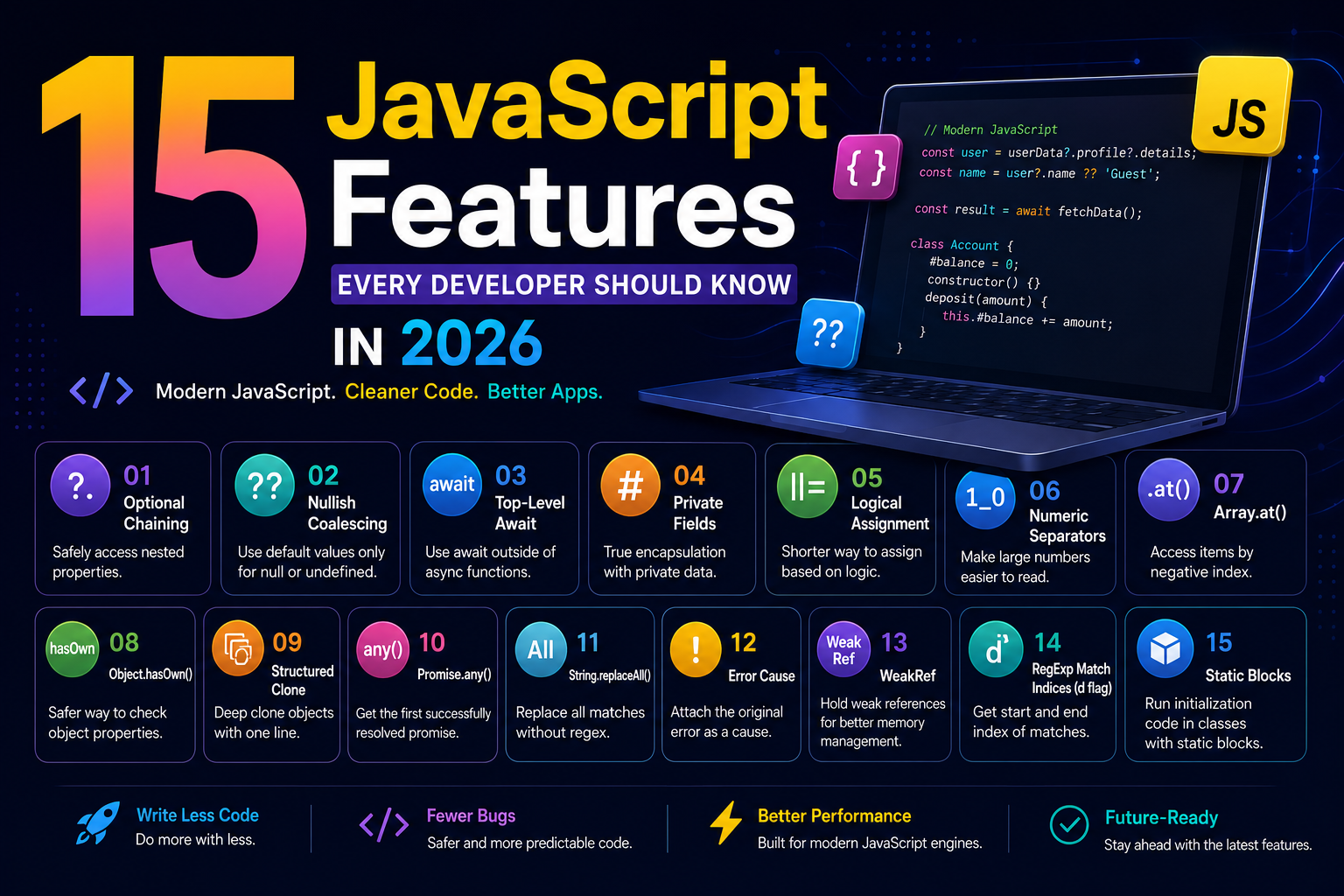
JavaScript has evolved dramatically over the past few years. Features that once required Babel plugins or complicated workarounds are now part of the language itself.
If you're still writing JavaScript the same way you did five years ago, you're probably writing more code than necessary.
Modern JavaScript isn't just about writing less code—it's about writing safer, more readable, and more maintainable applications.
Whether you're building React applications, Node.js APIs, Vue projects, or full-stack applications, these features will improve your productivity immediately.
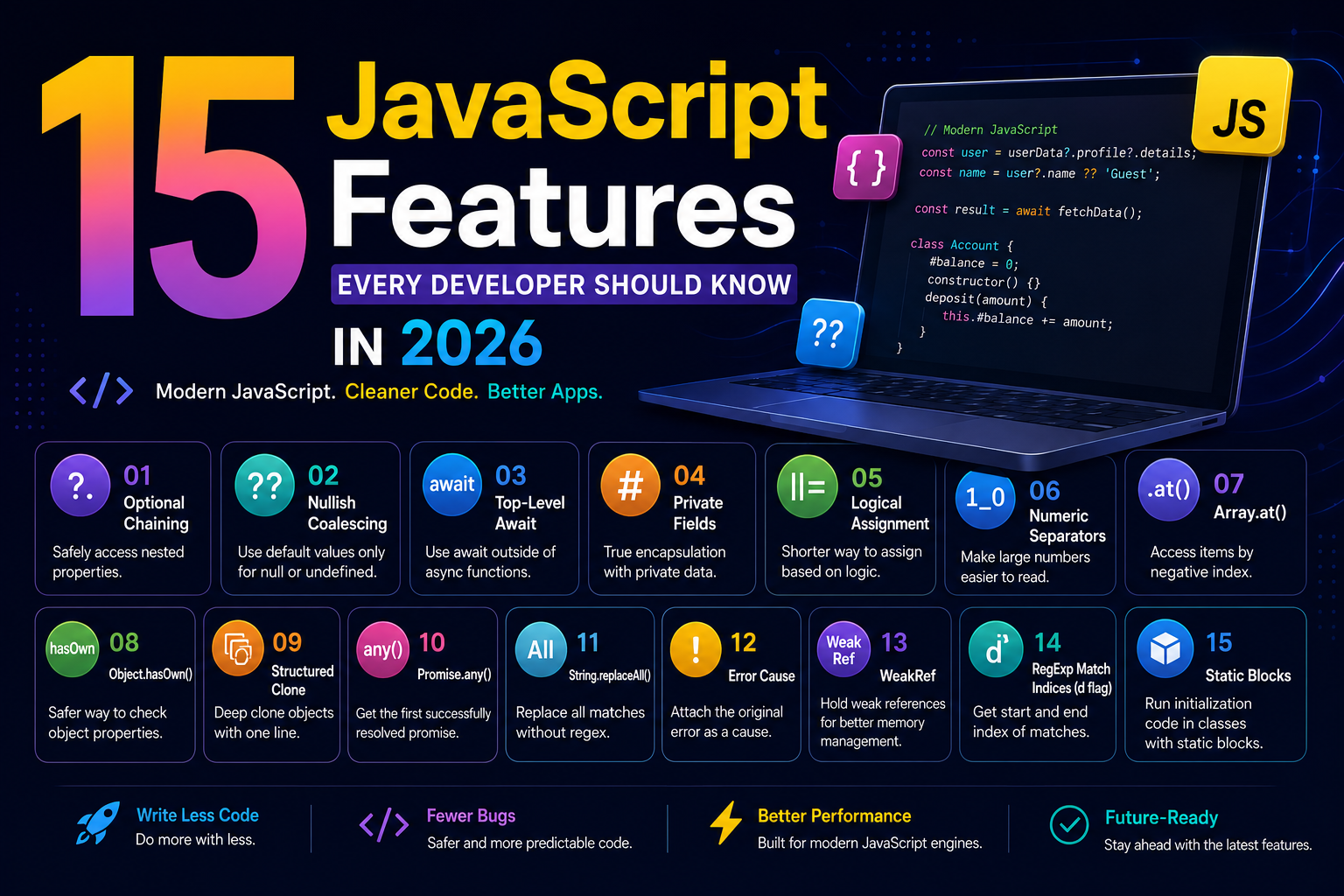
Let's dive into the 15 JavaScript features every developer should know in 2026.
1. Optional Chaining (?.)
One of the most useful additions to JavaScript.
Instead of checking every nested object manually, optional chaining safely accesses properties without throwing an error.
Before
if (
    user &&
    user.profile &&
    user.profile.address &&
    user.profile.address.city
) {
    console.log(user.profile.address.city);
}
After
console.log(user?.profile?.address?.city);
If any property is null or undefined, JavaScript simply returns undefined.
Perfect for:
API responses
Nested objects
Optional configurations
2. Nullish Coalescing (??)
Many developers still use ||.
That can lead to unexpected behaviour.
const age = 0;

console.log(age || 18); // 18 ❌
Instead:
console.log(age ?? 18); // 0 ✅
?? only falls back when the value is:
nullundefined
Not when it's:
0
""
false
3. Top-Level Await
Before ES modules, asynchronous initialization required wrapping everything inside an async function.
const response = await fetch("/api/users");
const users = await response.json();

console.log(users);
No wrapper function needed.
This makes startup code much cleaner.
Especially useful in:
Node.js
Vite
Next.js
Bun
Deno
4. Private Class Fields (#)
Private properties are now built into JavaScript.
class BankAccount {

    #balance = 0;

    deposit(amount){
        this.#balance += amount;
    }

    getBalance(){
        return this.#balance;
    }

}
Trying to access:
account.#balance
will throw an error.
This provides true encapsulation.
5. Logical Assignment Operators
Instead of:
user.name = user.name || "Guest";
Use:
user.name ||= "Guest";
Also available:
user.age ??= 18;

settings.enabled &&= false;
Cleaner.
Shorter.
More expressive.
6. Numeric Separators
Large numbers become much easier to read.
const population = 1_450_000_000;

const budget = 12_500_000;

const bytes = 1_024;
JavaScript ignores the underscores.
7. Array.at()
Instead of:
const last = arr[arr.length - 1];
Use:
const last = arr.at(-1);
Examples:
arr.at(0);

arr.at(2);

arr.at(-1);

arr.at(-2);
Much more readable.
8. Object.hasOwn()
Instead of:
obj.hasOwnProperty("name");
Use:
Object.hasOwn(obj, "name");
Safer and works even when objects don't inherit from Object.prototype.
9. Structured Clone
Deep cloning objects has never been easier.
Before:
JSON.parse(JSON.stringify(obj));
Problems:
loses Dates
loses Maps
loses Sets
loses undefined
Modern solution:
const copy = structuredClone(original);
Fast.
Reliable.
Native.
10. Promise.any()
Runs multiple promises and returns the first successful result.
const result = await Promise.any([
    fetch(api1),
    fetch(api2),
    fetch(api3)
]);
Perfect for:
multiple mirrors
fallback APIs
CDN requests
11. replaceAll()
Instead of regex:
text.replace(/dog/g, "cat");
Simply write:
text.replaceAll("dog", "cat");
Cleaner and easier to understand.
12. Error Cause
Wrapping errors while keeping the original context.
try {

    connectDB();

}
catch(error){

    throw new Error("Database connection failed", {
        cause: error
    });

}
Later:
console.log(error.cause);
Great for debugging production applications.
13. WeakRef
Useful for advanced memory management.
const cache = new WeakRef(expensiveObject);

const obj = cache.deref();

if (obj) {

    console.log("Still exists");

}
Most developers won't need it daily, but it's valuable for caching libraries and large applications.
14. Static Initialization Blocks
Classes can initialize static values immediately.
class Config {

    static settings;

    static {

        this.settings = loadSettings();

    }

}
Great for application bootstrapping.
15. RegExp Match Indices (d Flag)
Need to know exactly where a match occurred?
const regex = /(JavaScript)/d;

const match = regex.exec("I love JavaScript");

console.log(match.indices);
Useful for:
code editors
syntax highlighting
parsers
search tools
Bonus: Features You Should Already Be Using
If you aren't already using these daily, now is the time.
Destructuring
const { name, email } = user;
Spread Operator
const updated = {
    ...user,
    active: true
};
Template Literals
const message = `Welcome ${user.name}`;
Arrow Functions
const square = n => n * n;
Default Parameters
function greet(name = "Developer") {
    console.log(`Hello ${name}`);
}
Why These Features Matter
Modern JavaScript isn't about memorising syntax.
It's about solving common problems with less code and fewer bugs.
Using these features helps you:
✅ Write cleaner code
✅ Reduce boilerplate
✅ Improve readability
✅ Prevent runtime errors
✅ Build maintainable applications
✅ Work more effectively with modern frameworks like React, Vue, Angular, Svelte, and Node.js
Companies increasingly expect developers to be comfortable with these modern language features, especially when working on large codebases.
Final Thoughts
JavaScript continues to evolve every year, and keeping up with the language is one of the best investments you can make as a developer.
You don't need to adopt every new feature immediately, but incorporating even a handful of these into your daily workflow can make your code significantly cleaner, safer, and easier to maintain.
Start with Optional Chaining, Nullish Coalescing, Top-Level Await, and Private Class Fields. These alone will noticeably improve the quality of your code.
As the JavaScript ecosystem continues to grow, developers who embrace modern language features will spend less time fighting boilerplate and more time building great products.
What's Your Favourite JavaScript Feature?
Have you already started using these modern JavaScript features, or is there one that completely changed how you write code?
Share your favourite feature—or one we missed—in the comments. Let's help other developers write better JavaScript together.
If you found this article helpful, consider sharing it with your team or fellow developers. It might just save someone from writing hundreds of unnecessary lines of code.



Comments