
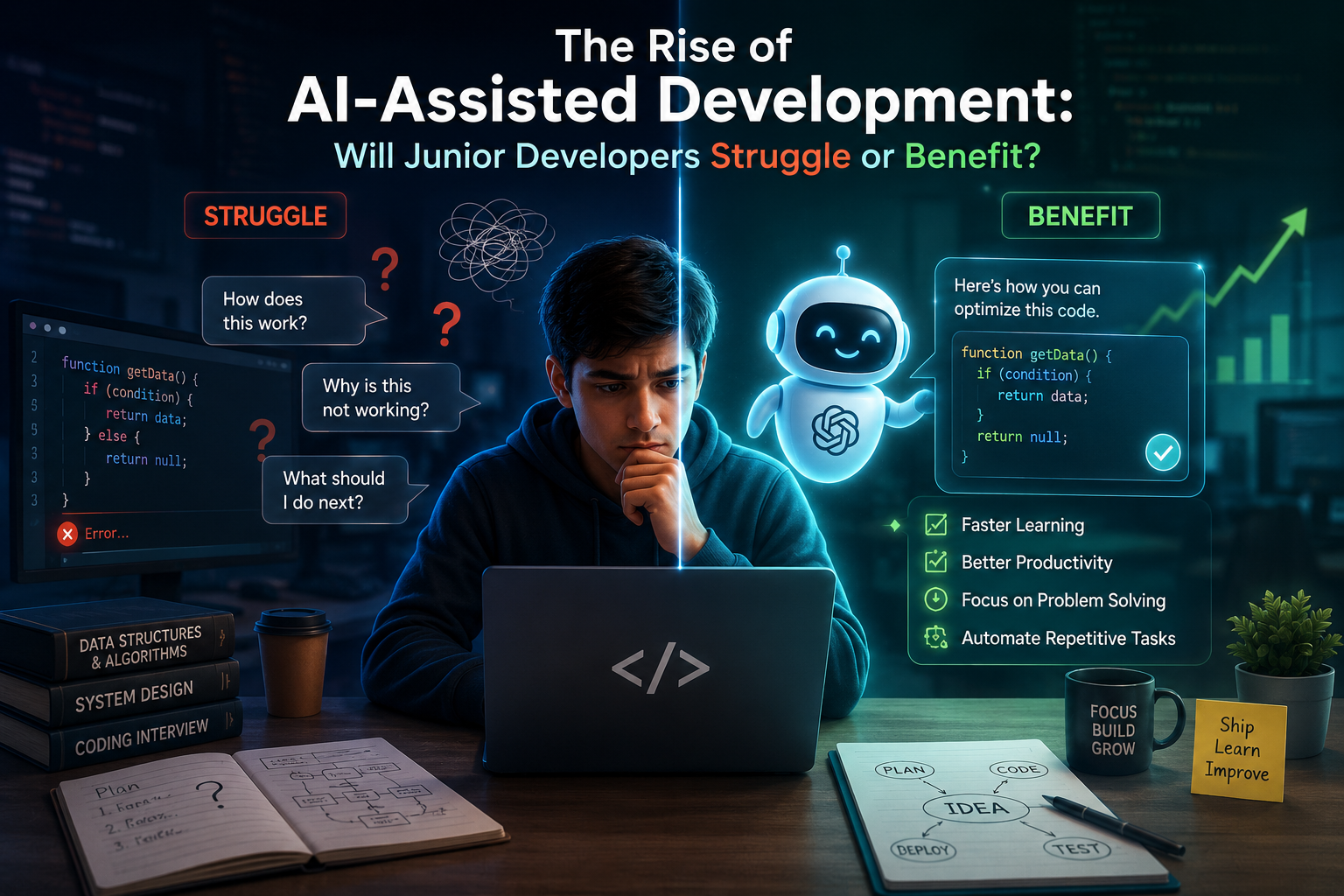
The Rise of AI-Assisted Development: Will Junior Developers Struggle or Benefit?
A few years ago, developers searched Stack Overflow for answers.
Today?
Many developers open an AI assistant before opening documentation.
Whether it’s:
generating React components,
debugging TypeScript errors,
writing SQL queries,
creating API endpoints,
or explaining regex patterns,
AI-assisted development has rapidly become part of everyday engineering workflows.
Tools like:
are fundamentally changing how developers write software.
And that raises a massive question for the industry:
Will AI help junior developers grow faster — or make it harder for them to become truly skilled engineers?
The answer is more nuanced than most hot takes online suggest.
Because AI is neither a magic replacement for developers nor an apocalypse for programming careers.
But it is reshaping how developers learn, think, and work.
Let’s break down what’s actually happening.
AI-Assisted Development Is Already Here
This isn’t a future prediction anymore.
AI-generated code is already shipping to production daily.
Modern AI tools can:
Generate boilerplate instantly
Explain unfamiliar codebases
Refactor components
Write unit tests
Create documentation
Detect bugs
Suggest performance improvements
Translate between languages/frameworks
A junior developer can now scaffold a feature in minutes that previously took hours.
For example, generating a quick API route in Next.js:
import { NextResponse } from "next/server";

// Simple API route generated with AI assistance
export async function GET() {
  return NextResponse.json({
    message: "Hello from AI-assisted development",
  });
}
Or creating a reusable React hook:
import { useEffect, useState } from "react";

// Custom hook for online/offline detection
export function useOnlineStatus() {
  const [isOnline, setIsOnline] = useState(navigator.onLine);

  useEffect(() => {
    const goOnline = () => setIsOnline(true);
    const goOffline = () => setIsOnline(false);

    window.addEventListener("online", goOnline);
    window.addEventListener("offline", goOffline);

    return () => {
      window.removeEventListener("online", goOnline);
      window.removeEventListener("offline", goOffline);
    };
  }, []);

  return isOnline;
}
Ten years ago, beginners had to discover patterns like these manually through tutorials, forums, and documentation.
Now AI can generate them instantly.
That changes the learning process dramatically.
Why AI Can Be Incredible for Junior Developers
Let’s start with the positive side.
Because honestly?
AI tools can accelerate learning massively when used correctly.
1. Faster Feedback Loops
One of the hardest parts of learning programming is getting stuck.
A beginner might spend:
3 hours debugging syntax,
misunderstanding error messages,
or searching outdated forum posts.
AI reduces that friction.
Instead of:
TypeError: Cannot read properties of undefinedA junior developer can ask:
“Why is this happening?”
And get:
explanations,
examples,
fixes,
and debugging guidance instantly.
That shortens the feedback loop dramatically.
And faster feedback usually means faster learning.
2. AI Makes Exploration Easier
Junior developers often avoid advanced topics because they feel intimidating.
Things like:
WebSockets
Authentication
Docker
TypeScript generics
State management
Caching
Testing
AI lowers the barrier to experimentation.
A developer can now say:
“Show me how JWT authentication works in Express.”
And instantly get a working example:
import jwt from "jsonwebtoken";

const token = jwt.sign(
  { userId: 123 },
  process.env.JWT_SECRET,
  { expiresIn: "1h" }
);

console.log(token);
This encourages curiosity.
And curiosity is one of the most valuable traits in engineering.
3. Boilerplate Work Becomes Less Painful
Let’s be honest.
Not all coding is intellectually rewarding.
A huge amount of development involves repetitive tasks:
form validation,
CRUD operations,
config setup,
API wiring,
repetitive TypeScript types,
documentation.
AI excels at reducing this kind of repetitive effort.
That allows developers to focus more on:
architecture,
user experience,
performance,
and problem-solving.
Which is where real engineering value exists.
But There’s Also a Serious Risk
AI can absolutely make developers worse if used incorrectly.
Especially junior developers.
Because there’s a huge difference between:
✅ Using AI as a learning accelerator
and
❌ Using AI as a thinking replacement
That distinction matters.
A lot.
The Biggest Danger: “Autocomplete Engineering”
Some developers are starting to build applications they don’t actually understand.
They:
paste AI-generated code,
tweak random lines,
and hope everything works.
Until production breaks.
Then they’re stuck.
This creates a dangerous illusion of competence.
A junior developer may appear productive while lacking:
debugging skills,
architecture understanding,
performance awareness,
or core JavaScript knowledge.
For example, AI might generate this:
useEffect(() => {
  fetchData();
}, []);
Looks fine, right?
But what if:
fetchDatachanges?dependencies are missing?
race conditions exist?
cleanup is required?
Without foundational knowledge, developers can’t evaluate AI output critically.
And that’s the real problem.
AI Is Great at Generating Code — Not Judgement
This is the key insight many developers miss.
AI can:
generate syntax,
scaffold components,
explain APIs.
But engineering is much more than writing syntax.
Real software engineering involves:
tradeoffs,
scalability,
maintainability,
performance,
accessibility,
security,
debugging,
communication.
AI doesn’t truly “understand” your system architecture.
It predicts likely code patterns.
Sometimes those patterns are excellent.
Sometimes they’re dangerously wrong.
Junior developers still need strong fundamentals to separate good solutions from bad ones.
The Developers Who Will Thrive in the AI Era
The industry is shifting toward a different kind of developer.
Not developers who memorize syntax.
But developers who can:
think critically,
validate AI output,
design systems,
debug effectively,
and communicate clearly.
The most valuable engineers in the AI era will be the ones who combine:
1. Strong Fundamentals
Understanding:
JavaScript,
networking,
databases,
rendering,
state management,
algorithms,
architecture.
2. AI Collaboration Skills
Knowing:
how to prompt effectively,
refine outputs,
verify code,
and use AI strategically.
3. Debugging Ability
AI-generated code still breaks.
Developers who can debug complex systems will remain incredibly valuable.
4. Product Thinking
Understanding:
users,
business goals,
UX,
scalability,
and reliability.
AI can generate code.
It cannot replace product intuition.
Junior Developers Should Learn With AI — Not Instead Of Learning
This is probably the healthiest mindset.
Use AI to:
accelerate learning,
explain concepts,
review code,
explore unfamiliar technologies,
generate starting points.
But still:
read documentation,
debug manually,
build projects from scratch,
and understand why code works.
For example, if AI generates this optimization:
const expensiveValue = useMemo(() => {
  return calculateHeavyData(data);
}, [data]);
Don’t stop at “it works.”
Ask:
Why use
useMemo?What problem does it solve?
When is memoization harmful?
What are the tradeoffs?
That’s where real growth happens.
The Industry Is Probably Not Reducing the Need for Developers
It’s changing the expectations.
Companies may eventually hire:
fewer “pure implementation” developers,
but more developers who can own systems end-to-end.
AI increases leverage.
Developers who adapt become dramatically more productive.
And historically, productivity tools tend to increase software demand — not eliminate it.
The web didn’t disappear because frameworks became easier.
It expanded.
The same will likely happen with AI-assisted development.
Practical Advice for Junior Developers Right Now
If you’re early in your career, here’s the smartest path forward:
✅ Learn Core Fundamentals Deeply
Especially:
JavaScript
React rendering
APIs
async programming
databases
HTTP
Git
✅ Use AI as a Mentor, Not a Crutch
Ask AI:
“Explain this.”
“Why is this bad?”
“What are alternatives?”
“What tradeoffs exist?”
Not just:
“Generate everything.”
✅ Build Real Projects
Nothing replaces:
debugging,
deployment,
architecture decisions,
production mistakes.
That’s where engineering maturity develops.
✅ Read Other People’s Code
AI-generated code often lacks production nuance.
Study:
open-source projects,
senior developer code,
architecture discussions.
✅ Learn Debugging Early
This skill becomes even more valuable in the AI era.
Because someone still needs to fix the broken abstraction layers.
Final Thoughts
AI-assisted development is not killing software engineering.
But it is changing what it means to be a valuable developer.
Junior developers who rely entirely on AI without understanding fundamentals may struggle long term.
But developers who combine:
foundational knowledge,
critical thinking,
and AI-assisted productivity
could become better engineers faster than any previous generation.
The future probably doesn’t belong to:
developers who reject AI,
or developers who blindly trust it.
It belongs to developers who know how to collaborate with it intelligently.
Key Takeaways
✅ AI dramatically accelerates development workflows
✅ Junior developers can learn faster with AI tools
✅ Over-reliance on AI creates shallow understanding
✅ Fundamentals still matter more than ever
✅ Debugging and system thinking remain critical skills
✅ The future favors developers who combine engineering knowledge with AI collaboration
Conclusion
The real question isn’t:
“Will AI replace junior developers?”
It’s:
“Will junior developers evolve alongside AI?”
Because AI is quickly becoming part of the standard developer toolkit.
And just like:
Stack Overflow,
GitHub,
frameworks,
and cloud platforms,
developers who learn to use it effectively will gain a major advantage.
But the developers who truly stand out will still be the ones who understand the systems underneath the generated code.
How are you using AI in your development workflow today?
Do you think AI is making junior developers stronger — or creating a generation of engineers who can ship code without understanding it?
Share your thoughts and experiences in the comments.


Comments